

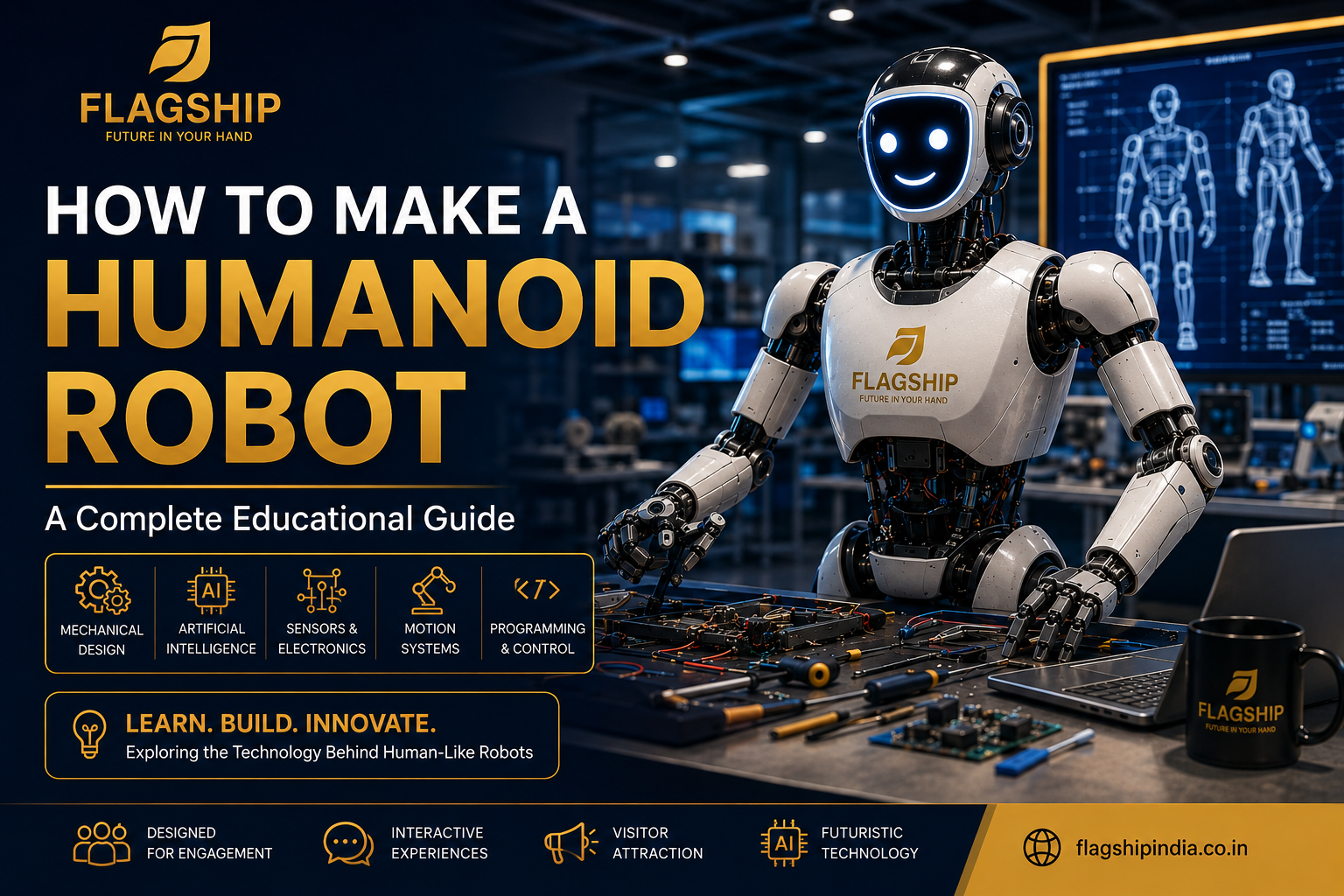
Humanoid robots are one of the most fascinating developments in modern robotics. Designed to resemble the human body and interact with people in natural environments, these robots combine mechanical engineering, electronics, artificial intelligence, computer vision, sensors, and advanced software.
But how do you actually make a humanoid robot?
Building a humanoid robot is a multidisciplinary engineering challenge. It requires much more than simply creating a human-shaped machine. A functional humanoid robot needs a mechanical body, motors and actuators for movement, sensors for perception, a control system for coordination, and software that allows it to understand and respond to its surroundings.
This guide from Flagship Robots explains the major components and development stages involved in creating a humanoid robot from an educational perspective.
What Is a Humanoid Robot?
A humanoid robot is a robot designed with a body structure inspired by humans. It typically includes a head, torso, two arms, two legs, and hands or other end-effectors.
The purpose of a humanoid design is not necessarily to copy humans perfectly. Instead, the human-like structure can help robots operate in environments designed for people, such as offices, schools, exhibitions, homes, factories, and public spaces.
Modern humanoid robots may use artificial intelligence to recognize objects, understand speech, identify people, navigate spaces, and perform specific tasks.
What Are the Main Components of a Humanoid Robot?
Creating a humanoid robot requires several major systems working together.
1. Mechanical Structure
The mechanical structure forms the physical body of the robot.
Engineers need to design components such as:
- Head and neck
- Torso
- Shoulders
- Arms
- Elbows
- Wrists
- Hands
- Hips
- Knees
- Ankles
- Feet
The materials used depend on the robot’s size, weight, purpose, and budget. Aluminum alloys, carbon-fiber components, engineering plastics, and other lightweight materials can be used in different applications.
The structure needs to be strong enough to support the robot while remaining light enough for efficient movement.
2. Actuators and Motors
Motors and actuators allow the robot to move.
A humanoid robot may require multiple independently controlled joints. For example, the shoulder can require several degrees of movement, while the knee primarily requires rotational movement.
Common technologies include:
- Servo motors
- Brushless motors
- Gearboxes
- Linear actuators
- Harmonic-drive systems
The actuator selection depends on the required torque, speed, precision, weight, and operating environment.
3. Sensors
A robot needs sensors to understand what is happening around it and monitor its own condition.
Depending on the application, a humanoid robot can use:
- Cameras
- Depth sensors
- LiDAR
- Microphones
- Inertial Measurement Units (IMUs)
- Force sensors
- Touch sensors
- Joint-position sensors
- Temperature sensors
For example, cameras can provide visual information while an IMU can help estimate the robot’s orientation and movement.
4. Computing Hardware
The robot needs a computer or embedded computing platform to process sensor data and run its software.
A humanoid robot may have separate computing systems for different tasks, including:
- Motion control
- Computer vision
- Speech processing
- Artificial intelligence
- Navigation
- Sensor processing
More advanced robots can use powerful processors or GPUs for AI-based perception and decision-making.
5. Power System
A mobile humanoid robot needs an independent power source.
Rechargeable battery systems are commonly considered because the robot needs to supply energy to motors, computers, sensors, communication systems, and other electronics.
Battery capacity directly affects operating time, while battery weight affects mobility.
Therefore, engineers have to balance energy capacity with the robot’s overall weight and performance.
How Does a Humanoid Robot Move?
Movement is one of the most challenging parts of humanoid robotics.
Unlike a wheeled robot, a humanoid robot must coordinate multiple joints while maintaining balance.
For example, when a robot takes a step, its control system may need to coordinate:
- Body position
- Hip movement
- Knee movement
- Ankle position
- Foot placement
- Balance
- Sensor feedback
This requires real-time control algorithms.
Engineers often use feedback from joint sensors and IMUs to continuously adjust motor commands.
How Does AI Work in a Humanoid Robot?
Artificial intelligence can provide a higher level of intelligence to a humanoid robot.
AI systems can help robots perform tasks such as:
- Speech recognition
- Natural-language interaction
- Object recognition
- Face detection
- Scene understanding
- Gesture recognition
- Decision-making
- Human-robot interaction
For example, a humanoid robot at an event could potentially recognize a visitor, understand a question, retrieve relevant information, and respond using speech.
AI does not replace the robot’s mechanical and control systems. Instead, it works alongside them.
How Is a Humanoid Robot Programmed?
Humanoid robots usually rely on multiple layers of software.
A simplified architecture can include:
Sensors → Perception → AI/Decision Layer → Motion Planning → Motor Control → Physical Movement
Robotics frameworks and programming languages can be used to develop these systems.
Robot Operating System (ROS/ROS 2), C++, Python, embedded programming, simulation platforms, and AI frameworks are commonly associated with modern robotics development.
Simulation is especially useful because engineers can test movement and software before running them on physical hardware.
The Importance of Balance and Safety
Safety is one of the most important considerations when developing humanoid robots.
A robot with powerful motors can potentially cause injury if it moves unexpectedly or loses balance.
Therefore, professional robot development may include:
- Emergency stop systems
- Torque and current limits
- Collision detection
- Safe operating zones
- Fall detection
- Software safety limits
- Mechanical safeguards
- Battery protection
- Remote monitoring
Testing should be performed gradually, beginning with individual components before progressing to complete movements.
How Long Does It Take to Make a Humanoid Robot?
There is no single answer.
A small educational prototype can be developed much faster than a sophisticated commercial humanoid robot.
The development timeline depends on:
- Robot size
- Number of joints
- AI capabilities
- Mobility requirements
- Hardware complexity
- Manufacturing requirements
- Software integration
- Testing requirements
A basic prototype may demonstrate simple movements, while an advanced humanoid robot can require years of research, engineering, testing, and refinement.
Where Are Humanoid Robots Used?
Humanoid robots are being explored across multiple industries.
Potential applications include:
Events and Exhibitions
Humanoid robots can attract visitors and create interactive experiences at exhibitions, conferences, malls, product launches, and corporate events.
Education
Robots can be used to introduce students to programming, artificial intelligence, electronics, and robotics.
Hospitality
Humanoid robots can potentially assist with information desks, visitor engagement, greetings, and other customer-facing activities.
Healthcare and Assisted Living
Researchers are exploring humanoid robots for assistance, communication, and support-related applications.
Research and Development
Universities, robotics laboratories, and technology companies use humanoid platforms to study artificial intelligence, locomotion, perception, and human-robot interaction.
Can You Build a Humanoid Robot at Home?
A simple educational robot can be created as a learning project using commercially available components.
However, building a sophisticated, human-sized humanoid robot capable of walking, balancing, interacting naturally, and operating safely is considerably more difficult.
Such systems require expertise across mechanical engineering, electronics, embedded systems, software development, AI, control engineering, and robotics.
For commercial applications, professional engineering and testing are strongly recommended.
The Future of Humanoid Robotics
Humanoid robotics is developing rapidly as AI, sensors, actuators, batteries, and computing hardware improve.
The combination of advanced AI with increasingly capable robotic hardware could enable robots to interact with people more naturally and perform a wider range of tasks.
Companies such as Flagship Robots are part of this growing ecosystem, bringing robotic experiences closer to real-world environments through interactive robotics and technology experiences.
The goal of humanoid robotics is not simply to create machines that look human. The larger objective is to build intelligent machines capable of safely interacting with people and operating in environments designed around human needs.
Conclusion
Making a humanoid robot is a complex engineering process that combines mechanical design, motors, sensors, electronics, computing, artificial intelligence, software, and safety systems.
From designing the robot’s skeleton to programming its movements and developing AI-based interaction, every component needs to work together.
For students, technology enthusiasts, businesses, and robotics professionals, understanding these building blocks is the first step toward understanding the future of humanoid robotics.
At Flagship Robots, we believe robotics is not just about machines—it is about creating memorable technology experiences and exploring how intelligent robots can interact with the world around us.
Frequently Asked Questions
1. How much does it cost to make a humanoid robot?
The cost varies significantly depending on the robot’s size, number of joints, sensors, AI capabilities, materials, and manufacturing requirements. An educational prototype can cost far less than a commercial humanoid robot.
2. What programming language is used for humanoid robots?
C++ and Python are widely used in robotics. Embedded programming and robotics frameworks such as ROS/ROS 2 can also be part of a humanoid robot’s software stack.
3. Does a humanoid robot need artificial intelligence?
Not necessarily. A robot can perform predefined movements without AI. However, AI can provide advanced capabilities such as speech understanding, computer vision, object recognition, and natural interaction.
4. How many motors does a humanoid robot need?
There is no fixed number. It depends on the robot’s design and degrees of freedom. A simple robot may have relatively few actuators, while advanced humanoids can have many independently controlled joints.
5. Can humanoid robots walk like humans?
Yes, humanoid robots can be designed to walk using coordinated joint movements, balance control, sensors, and motion-planning algorithms. Human-like walking remains a complex challenge in robotics.
6. What sensors are used in humanoid robots?
Common sensors include cameras, depth sensors, IMUs, microphones, force sensors, touch sensors, and joint-position sensors.
7. Can I make a humanoid robot as a student project?
Yes. Educational humanoid robotics projects can be excellent ways to learn mechanical design, electronics, programming, sensors, and robotics. A small-scale prototype is generally a more practical starting point than attempting a full-size commercial robot.
8. Where can humanoid robots be used?
Humanoid robots can be used or explored in education, research, events, exhibitions, hospitality, customer engagement, entertainment, healthcare research, and other human-centered environments.
9. What is the hardest part of making a humanoid robot?
Walking, balance, real-time control, safe physical interaction, power management, and integrating AI with robotics hardware are among the most challenging aspects.
10. What is the future of humanoid robots?
As AI, batteries, sensors, actuators, and computing systems improve, humanoid robots are expected to become more capable and useful across research, commercial, educational, entertainment, and human-interaction applications.